
UPDATE: Golf Australia has announced proposed changes to the Australian Golf Handicap System to be rolled out in September 2011. Click here to read the update
Here is everything you need to know about the new Australian Golf Handicap System adopted by Golf Australia and Golflink.
There are two major differences that Australian golfers will experience with the new handicapping system:
Part 1: Calculating your Handicap:
The first major difference is how your handicap is calculated. Whereas the old Australian system had an intricate scheme of differentials and buffer zones, the USGA’s “handicap index” is calculated by averaging the best 8 of your last 20 scores. Simple.
The new system will be used to calculate the Australian Men’s and Women’s handicaps, and is the first step on the way to full adoption of the USGA Handicap System.
The new system: explained
The new system calculates an exact handicap by averaging the best 8 differentials (differential = gross score – AMCR/AWCR) of your 20 most recent valid scores), then multiplying that number by 0.93 and truncated to 1 decimal point.
The 0.93 is referred to as the “bonus for excellence” as described in the USGA Handicap System. In essence, this multiplier favours the low handicappers — and thus gives all golfers the incentive to lower their handicap – as the 0.93 factor results in a smaller reduction in lower handicaps versus higher ones.
GOLF Link, which manages the handicaps across Australia, has posted a Q&A Page on their website which answers many of the common questions that golfers have been asking throughout the last year. For more information: Golf Australia website
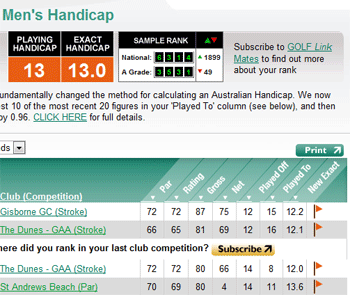
An example of how the handicap system will work is shown in the following table published by GOLF Link.
‘Rolling Sample’ Handicap Calculation Method. Example:
| The example to the right shows a golfer’s last 20 scores with the best 8 “Played To” differentials highlighted.
To calculate this player’s handicap we average out those 8 differentials (average of 17, 17, 12, 15, 13, 13, 15, 13) which gives us a value of 14.3. This is then multiplied by 0.93 (the bonus for excellence) to give 13.368. Finally any numbers after the 1st decimal point are truncated (deleted) to arrive at an exact handicap of 13.3. This in turn is rounded to a playing handicap of 13. |
Round | Gross Score | AMCR | Played to |
| 1st Most Recent Round | 87 | 70 | 17 | |
| 2nd Most Recent Round | 87 | 70 | 17 | |
| 3rd Most Recent Round | 94 | 70 | 24 | |
| 4th Most Recent Round | 89 | 70 | 19 | |
| 5th Most Recent Round | 92 | 70 | 22 | |
| 6th Most Recent Round | 82 | 70 | 12 | |
| 7th Most Recent Round | 85 | 70 | 15 | |
| 8th Most Recent Round | 93 | 70 | 23 | |
| 9th Most Recent Round | 90 | 70 | 20 | |
| 10th Most Recent Round | 89 | 70 | 19 | |
| 11th Most Recent Round | 83 | 70 | 13 | |
| 12th Most Recent Round | 88 | 70 | 18 | |
| 13th Most Recent Round | 94 | 70 | 24 | |
| 14th Most Recent Round | 90 | 70 | 20 | |
| 15th Most Recent Round | 83 | 70 | 13 | |
| 16th Most Recent Round | 85 | 70 | 15 | |
| 17th Most Recent Round | 88 | 70 | 18 | |
| 18th Most Recent Round | 83 | 70 | 13 | |
| 19th Most Recent Round | 90 | 70 | 20 | |
| 20th Most Recent Round | 89 | 70 | 19 |
This is hoped to produce a more accurate handicap that better reflects your current/recent playing status as well as your future potential. It will also be very beneficial to players who, for example, may have suffered a dip in form, or conversely, those who may have had one lucky “day out” round. Thus, under the old system whereas players could only “blow out” by just 0.1 of a shot each time they fail to play to their handicap, the USGA system allows players undergoing a “rough patch” to see a few more strokes added to their handicap a bit faster than before. Of course, this opens the door to the potential handicap “manipulation” by dishonest players. To combat this (and other concerns), the USGA has an Equitable Stroke Control system in place.
A note on Equitable Stroke Control:
ESC sets a maximum score per hole when calculating your handicap – and it is used to minimise the effects of “blowout holes” on your handicap.
For example, say you take an 8 on a par-3 (we’ve all been there). On its own, that snowman could potentially throw your handicap well out of whack. With Equitable Stroke Control, the 8 will count towards your total score for the daily comp, but not all of those extra strokes will count towards your handicap. Depending on your course handicap, the maximum you could claim towards your handicap might be a double-bogey 5. After subtracting all the “extra” shots from your round, the resulting score is your adjusted gross score, which is what is used to calculate your handicap.
Note that Golf Australia has applied for an amendment to Equitable Stroke Control, which would use a Stableford-type adjustment system, which would require players to adjust their score downward to what is effectively a net double bogey…effectively the lowest score that would give no Stableford points. If this still seems a bit complicated, don’t worry. In the US, they have a fully computerised system to do most of this work for you, and it would seem that a system like GolfLink could easily be tweaked to fit. In addition, tournament directors and club managers will likely be instructed on the “ins and outs” of the system.
Part 2: Course Rating vs Slope:
The old Australian system factored in a Course Rating which, while beneficial in comparing courses, does not really assist a golfer at the more difficult tracks. For example, if your handicap is 15, then under the old system you would play at a 15 at any course, regardless of its level of difficulty. In the USGA-based Slope system, however, your 15 “handicap index” would be converted to a “course handicap” based on the difficulty of the course. (Slope can range from 55 to 155, with 113 being considered a course of average difficulty.) So on a local/easy track, your handicap for the day may be, say, a 12, while on a monster it could be a 17 or 18. (Luckily, the USGA has calculators and charts to make this all simple for you.)
READ THE FULL STORY ON SLOPE RATING AND HOW IT AFFECTS YOUR HANDICAP HERE
To make the change, all of Australia’s 1600+ courses will be re-rated under the USGA stroke system. An army of course raters, recruited via the state golf associations under a selection criteria, are moving around the country undertaking the necessary changes.
Golf Australia believes the new system was long overdue. And they’re confident it will help increase golfers’ confidence in obtaining a golf handicap.
“This will provide the golfer with a greater sense of confidence in the robustness of the system itself,” Golf Australia rules and handicapping manager Simon Magdulski told Inside Golf.
“If you’re going to attract people to the game then you need to be giving them a quality product.
“I think this change will reassure people that they’ll be getting that and their handicap will be in line with international best practice.”
Magdulski doesn’t believe the current system has impacted on the development of golf.
He said it was impossible to pinpoint one reason why a golfer leaves the game or people don’t take it up.
“Golf Australia’s role is always to ensure it’s delivering the best outcome and ensuring we’re giving people a quality product.
“The better practices you have in place, the better opportunity you have to attract and retain people in the game.
“This has been a real positive for Golf Australia and the state associations.
“We believe it has the potential to flow into game development and retention.”
Magdulski said a uniform course rating system meant more consistent handicaps.
“The most obvious advantage of this process is being able to uniformly assess each course.
“That hadn’t been the case when we embarked on the process to improve the course rating system.
“That lack of uniformity was a material issue and it means that people’s handicaps become non-uniform.
“If everyone’s course rating is out then it’s not a problem. But that’s not the case so there are inconsistencies.”
Magdulski understands that club membership has stagnated in the past five years.
And while golf numbers remain strong, there’s a clear and evident shift towards social play.
He said Golf Australia was aware of the trends and would be undertaking the necessary work to ensure Australia’s handicap system could meet the needs of all golfers.
Interestingly, the task of rerating golf courses has generated plenty of interest in volunteering.
“What this has done is promoted a lot of people to become interested in volunteering,” Magdulski said.
“And I’d expect a lot of people who might not been used in this course rating process, might remain on databases and be able to volunteer in other exercises.
“It’s not something we contemplated, but it’s become a by-product of the rating changeover.”
Magdulski said course raters came from a diverse background but generally had considerable expertise.
“We’ve got people that have been great golfers, course designers and some people have a background in course administration.
“But they are all people with a passion for golf and a desire to make the game better.”
The Launch
In April of 2010, GOLF Link launched the new USGA-based system to calculate Australian golf handicaps, bringing more than 12 months of preparation (and anticipation) to a successful close.
Over the weekend of the launch, thousands of golfers (including yours truly) anxiously logged onto Golflink.com.au to check out how the new system had changed our handicaps. After a few minor delays –mostly due to GOLF Link smartly rolling out the changes in gradual steps to prevent massive server loads or website crashes — the new system was up and running.
Judy Pridmore, Golf Link CEO told Inside Golf “The launch created unprecedented levels of interest and activity on the Golf Link website. By the end of the handicapping changes, we had experienced nearly a month’s worth of traffic and are on track to hit a record 300,000 visitors and 3 million page impressions for April.”
The results of the switch, for some of us, were surprising.
Like many golfers out there, my own handicap went up by a full shot. Given my recent good form, however, I reckon it should be 1 or 2 shots lower (but please don’t tell my handicapper). Our publisher, Sam “the sandbagger” Arthur, also saw a 1-shot rise, though he’s arguing that, given his recent poor form, his new handicap should have been 5 shots higher still (tell him he’s dreamin!).
All kidding aside, our research has found that most handicaps haven’t been dramatically affected by the new system. On our web poll (www.insidegolf.com.au) we found that the majority of golfers (around 60%) stayed within 1 shot of their old handicap (see chart).
Phil Laurie, communications manager of Golf Queensland, says that the changes were inline with his expectations:
“The majority of players would have experienced a slight increase in handicap — which is what we expected given that players don’t play to their handicaps that often in competitions,” he said.
However, there were some truly big shifts for some of you out there.
Matthew Pitt, founder of the Bushranger Golf Social Club – which maintains active handicaps for over 160 of their 700 nationwide members – says there were some anomalies with the changeover, in particular among those with less than seven rounds in their history.
“We had one player – who only plays a few times a year — drop from 21 to 16 and a new member skyrocketed from 11 up to 26. A mate of mine who is a top amateur, went from a +1 to a +3, which is quite a jump at that level,” he said.
The move to the new system has not been without its critics. Players from all over the country have voiced their concerns about the changeover, claiming “if it ain’t broke, don’t fix it”. But many of us in the industry (myself included), have hailed the change as a positive step in the right direction.
“I’ve got to say that after all the analysis and presentations that I’ve done on the new system – the rolling handicap average is a far superior method to the old CCR calculation,” explains Laurie.
“It gives a much better representation of a player’s ability over a period of time. Before, you could have one blazing round and lose 1.5 strokes and then spend the next 6 months going out 0.1 each time you played,” he adds.
 A four-time winner of the Australian Golf Media Awards, including Best Photojournalism, Best Opinion, Best Column and Best Photographic Presentation, Inside Golf Group Editor Richard Fellner is the quintessential Golf Tragic, having played the game for over 50 years (but has never gotten any better!) He has played and reviewed courses all over the world, and has interviewed many of the great players of the game (including Jack Nicklaus, Tom Watson and Greg Norman). Richard is a member of both the Australian Golf Media Association and the Golf Society of Australia, and has been a featured guest on many Australian "sports talk" radio shows and networks, including ABC Grandstand, SEN 1116, Melbourne Talk Radio 1377, 2GB and others.
Follow
A four-time winner of the Australian Golf Media Awards, including Best Photojournalism, Best Opinion, Best Column and Best Photographic Presentation, Inside Golf Group Editor Richard Fellner is the quintessential Golf Tragic, having played the game for over 50 years (but has never gotten any better!) He has played and reviewed courses all over the world, and has interviewed many of the great players of the game (including Jack Nicklaus, Tom Watson and Greg Norman). Richard is a member of both the Australian Golf Media Association and the Golf Society of Australia, and has been a featured guest on many Australian "sports talk" radio shows and networks, including ABC Grandstand, SEN 1116, Melbourne Talk Radio 1377, 2GB and others.
Follow 



Pingback: How to Figure Out Your Golf Handicap in 5 Minutes | Talking Golf Online
Pingback: How to Figure Out Your Golf Handicap in 5 Minutes | How to break 100 in golf | Best golf swing tips for beginners